
Service Area vs Physical Location Businesses | Local SEO UK
Learn the difference between service area businesses and physical locations, and how Google ranks each in local search and Google Maps.
Joseph Agass
9/6/20253 min read
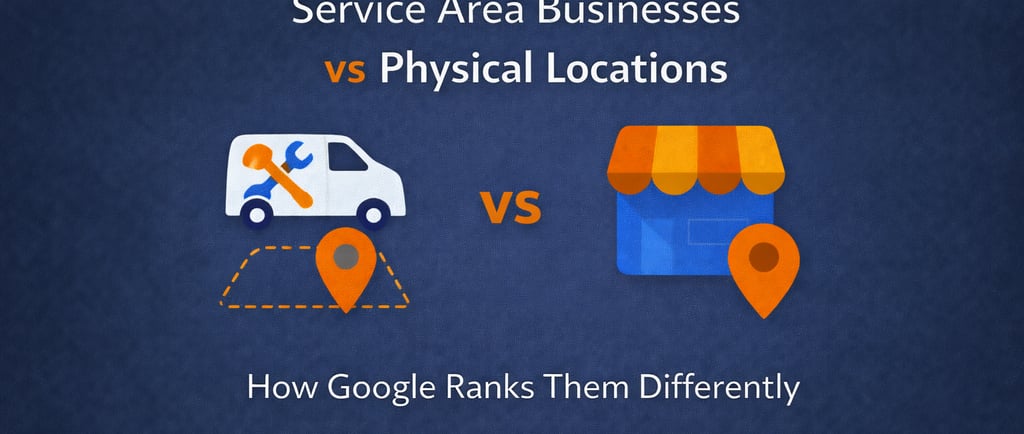

Service Area Businesses vs Physical Locations: How Google Ranks Them Differently
One of the most common sources of confusion in local SEO is the difference between service area businesses and physical location businesses.
Many UK businesses aren’t quite sure which category they fall into. Others assume it doesn’t really matter. In reality, this distinction affects how Google evaluates your business, how you appear in Google Maps, and how competitive your rankings can be.
Understanding this difference is essential if you want to rank consistently and avoid unnecessary issues with your Google Business Profile.
What Google Considers a Physical Location Business
A physical location business is one where customers visit the premises during stated opening hours. Examples include clinics, shops, salons, offices, and restaurants.
For these businesses, Google expects:
- A publicly accessible address
- Clear opening hours
- Visible signage
- Customer footfall
Because customers physically visit the location, Google uses the address as a strong proximity signal. This often gives physical businesses an advantage in very close-range searches.
However, that advantage comes with stricter verification requirements. Google is far more cautious about addresses that don’t clearly function as customer-facing premises.
What Google Considers a Service Area Business
A service area business is one that travels to customers rather than serving them at a fixed location. This includes trades, emergency services, home visits, and many professional services.
For these businesses, Google does not expect customers to visit the address. In fact, displaying an address when customers don’t actually visit can lead to suspensions.
Instead of relying on a visible address, Google evaluates service area businesses based on:
- Defined service areas
- Relevance to local searches
- Reviews and engagement
Overall prominence
This means rankings are influenced less by exact proximity and more by trust, relevance, and activity.
Why Rankings Behave Differently for Each Model
Physical location businesses tend to dominate very local searches close to their address. If someone searches within a short distance, Google heavily favours businesses with a nearby, verified location.
Service area businesses, on the other hand, can rank across wider areas. Because they are not tied to a single visible address, Google uses broader signals to decide where they should appear.
This is why a plumber can rank across multiple towns, while a dental clinic is usually strongest close to its physical location.
Neither model is “better”, but they require different optimisation approaches.
Common Mistakes Businesses Make
One of the biggest mistakes service area businesses make is trying to look like a physical location business.
Using virtual offices, shared workspaces, or residential addresses where customers never visit often leads to suspensions. Google’s guidelines are very clear on this, and enforcement has become stricter in recent years.
Physical businesses make different mistakes. Some hide their address unnecessarily, which removes a strong proximity signal and weakens their local visibility.
Choosing the wrong setup doesn’t just hurt rankings. It can remove you from Google Maps entirely.
How Google Evaluates Trust Differently
For physical locations, trust is closely tied to the legitimacy of the address. Google looks for consistency across signage, maps, websites, and third-party listings.
For service area businesses, trust is built through behaviour and prominence. Reviews, regular activity, service descriptions, and customer engagement play a much larger role.
This is why service area businesses with strong reviews and active profiles often outrank poorly maintained physical locations, even when they’re further away.
Optimising Correctly Based on Your Business Type
The most important step is alignment. Your Google Business Profile, website, and real-world operations must all match the same model.
If customers visit you, your address should be visible and well supported.
If you visit customers, your address should be hidden and your service areas clearly defined.
Once that foundation is correct, optimisation becomes far easier and more stable.
Why This Matters More in Competitive UK Markets
In competitive UK cities, small differences matter.
Choosing the correct business model affects:
- how wide an area you can rank in
- how stable your rankings are
- how vulnerable you are to suspensions
- how Google interprets proximity
Businesses that get this right early often enjoy more consistent visibility than competitors who constantly tweak settings without understanding the underlying model.
Final Thoughts
Service area businesses and physical location businesses are not ranked using the same logic. Treating them as if they are leads to poor results and unnecessary risk.
Google doesn’t reward clever setups. It rewards accurate ones.
If your Google Business Profile reflects how your business actually operates, rankings become easier to maintain, suspensions become less likely, and visibility improves over time.
Understanding this distinction is one of the simplest ways to gain an edge in local search.
Dominate your Local Market.
Built for local UK businesses
© 2026. All rights reserved.
Contact today
agassjoe@gmail.com
lukaswachter09@gmail.com
Email: